

Legal Instruments, Verification Authority, and Operational Readiness
The main security issue in the Middle East is not the absence of legal commitments, but the imbalance in verification authority across CBRN (Chemical, Biological, Radiological, and Nuclear) areas. That imbalance implies the absence of a single, coherent regional verification regime. The various treaties in the region have very different legal regimes for the different CBRN areas, which ultimately leads to a fragmented approach to CBRN non-proliferation.
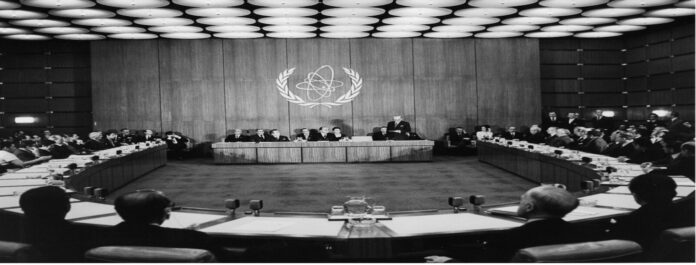
In the nuclear field, the Treaty on the Non-Proliferation (NPT) requires non-nuclear weapon states to place nuclear materials under International Atomic Energy Agency (IAEA) safeguards through Comprehensive Safeguards Agreements. The Additional Protocol further expands state declaration requirements and grants the IAEA broader access rights to strengthen its ability to detect undeclared nuclear activities. As a result, the nuclear domain benefits from the most developed international verification system. However, these safeguards are limited to nuclear materials and activities and do not provide a framework for verifying compliance across the wider CBRN spectrum.
Chemical weapons are subject to different institutional arrangements. The Organization for the Prohibition of Chemical Weapons (OPCW) possesses inspection and verification authority under the Chemical Weapons Convention, creating a comparatively robust compliance mechanism. By contrast, the Biological Weapons Convention (BWC) remains largely a treaty of prohibitions and national implementation obligations, lacking a comparable international verification organization or inspection regime. This longstanding verification gap remains one of the most significant structural weaknesses in global biological arms control.
The radiological domain presents additional complexities. Radiological security extends beyond safeguards for fissile material and cannot be treated as a simple extension of nuclear verification. Effective governance requires coordination among regulatory authorities, public health institutions, emergency responders, law enforcement agencies and judicial systems. Consequently, compliance depends not only on international legal commitments but also on national capabilities for detection, consequence management, clinical response, criminal investigation and prosecution.
These differences illustrate that the Middle East does not face a uniform CBRN governance environment. Instead, it operates through overlapping legal frameworks with varying levels of institutionalization, verification authority, and operational capacity. The resulting fragmentation complicates both regional confidence-building measures and coordinated responses to cross-domain threats.
Recent policy proposals have therefore shifted attention towards strengthening national and regional preparedness structures. Saudi Arabia’s Law of Nuclear and Radiological Control demonstrates that verification is not solely an international undertaking but is also embedded in domestic legislation. The law establishes the Nuclear and Radiological Regulatory Commission as the competent authority for licensing, inspection, safeguards implementation, nuclear material accounting, and emergency preparedness. It further requires licensees to maintain operational records, submit reports on nuclear and radioactive materials, and comply with safeguards obligations, while granting regulators authority to conduct inspections, collect samples, install monitoring equipment, and facilitate IAEA inspections. These provisions show how national legal frameworks can reinforce international verification by creating the institutional mechanisms needed to monitor compliance and respond to violations.
Geographic Scope and Asymmetric Verification
The 1995 Middle East Resolution called for a verifiable zone free of CBRN weapons and delivery systems, but there is no operational regional inspection regime in place. Israel is outside the NPT and accepts item-specific IAEA safeguards, raising questions about the extent of its retained capabilities. Because Riyadh retains the option of a domestic fuel cycle, it is unclear whether bilateral safeguards at the cooperative US–Saudi sites can substitute for a country-wide Additional Protocol. Saudi preparedness is equally broad, ranging from military bases and schools (al-Kharj and the 5th Air Defense Group Base, for example) to petrochemical and industrial sites, as well as civilian and medical institutions in Riyadh and elsewhere. The UAE, on the other hand, has a robust regime with the Barakah 4-unit nuclear power plant at its heart, a strong national regulatory framework, and full IAEA safeguards, the Additional Protocol, and a tight nuclear trade licensing regime. The UAE also has an Arabic-language criminal justice training facility.
Verification, Defense Exercises, Clinical Readiness, and Criminal Prosecution
The UAE has a full state system of nuclear material accounting and control, comprehensive safeguards, the Additional Protocol, import/export licensing, radioactive source transport inspections, and emergency drills. Saudi Arabia, on the other hand, withdrew from the Small Quantities Protocol in May 2025 and encouraged a US-Saudi program based on tailored monitoring of proliferation-sensitive activities. Joint drills such as Protection Shield III (January 2022) bring together USARCENT/DTRA and the Saudi military, Civil Defense, the Red Crescent, and the Health Ministry on chemical detection, decontamination, and mass-casualty response. The problem is uneven cross-branch participation, outdated sheltering and evacuation regulations, shelter shortages, and civil-military coordination issues. Commercial procurement simply cannot replace doctrine and sustainment drills.
Alahmari and Khan (2023) looked at 10 of the public hospitals in Riyadh (all with >100 beds and all with an ED) and found CBRN elements in 7 of the disaster plans, joint local drills in only 2, Class A biological symptom training in fewer than half, radiation detection equipment in half, rapid access to the medication stockpiles in half, and decontamination/item containment gaps.
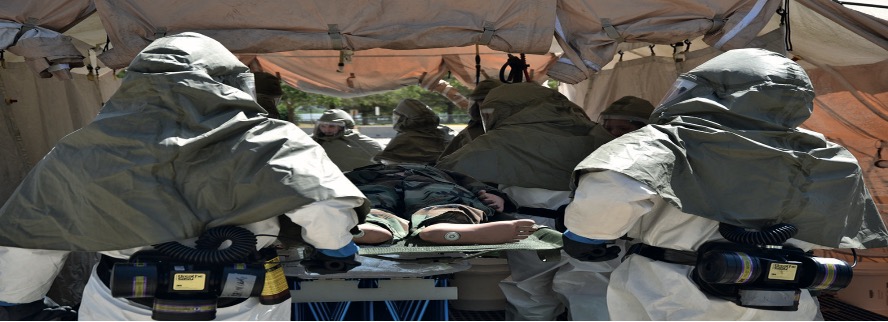
Shubayr (2026), in his study of Saudi emergency nurses, also points to a lack of knowledge and protocol at the frontline in the event of a chemical/CBRN incident, highlighting that clinical readiness requires ongoing training and supply-chain integration.
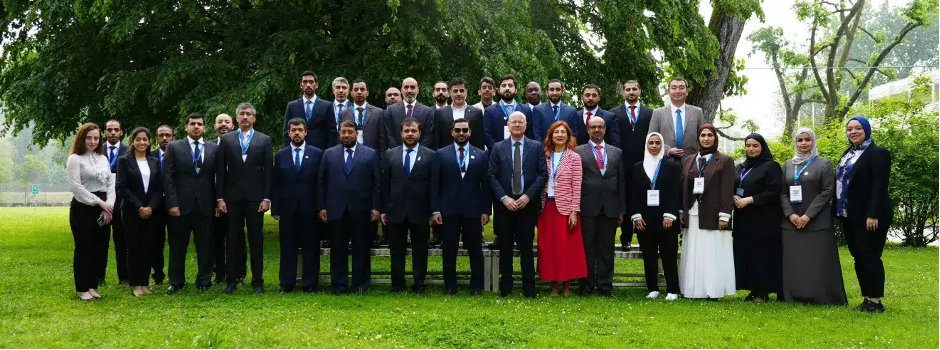
In parallel, the EU/UNICRI program launched in Abu Dhabi in November 2025 allowed to implement Phase III (Building a Case for Prosecution 26-30 January 2026), Phase IV (mock trial April 2026) and Phase V (train the trainer in Turin May 2026) to train prosecutors, investigators and partners from the UAE, Qatar, Oman and Kuwait on crime scene management, chain of custody, nuclear forensics (with IAEA and JRC), strategic trade controls, proliferation financing, mutual legal assistance and human rights / due process. This is supplemented by Project P116 on medical emergency response.
Energy, Hedging, Supply Chains, and Threat Exposure
Nuclear power enables grid expansion and hydrocarbon conservation. The Barakah plant, with its four commercial units (providing some 25% of the UAE’s electricity), clearly demonstrates that large-scale generation is possible without domestic enrichment, although reliance on an external fuel source means the supplier base needs to be diversified. The conditional Saudi statements on matching an Iranian nuclear weapon capability are of course a key driver of interest in both deterrence and defense, as are the past uses of chemical weapons in the region and the continued threat of drone, cyber and missile attacks on energy and petrochemical infrastructure. All of this is in the context of Riyadh’s continued assertion of its peaceful nuclear intentions. Industrial growth, the presence of transport hubs, and the nature of dual-use trade all increase the risk of exposure to illicit trafficking, proliferation financing, and incidents involving hazardous materials, so there is a corresponding drive to invest in legal, prosecutorial, and emergency management capacity.
Repercussions and Evolutions by Sector
Site-specific safeguards in place of a universal Additional Protocol risk creating a fragmented set of regional verification baselines and will hinder future negotiations on a Middle East WMD-free zone. A clear tension exists between the UAE’s 2008 ban on enrichment and reprocessing and Saudi domestic fuel cycle aspirations, testing whether a high level of nuclear output can be maintained in a regime otherwise committed to the same non-proliferation standards. The key benchmarks will be formal approval and the extent of IAEA monitoring powers. In the meantime, numerous initiatives could help strengthen the domestic rule of law, the chain of custody, due process, and inter-agency coordination. These include the UAE–UNICRI/EU IPA curriculum (Phase III prosecutorial training), the Farhat et al (2026) proposed National Emergency Management Advisory Council, and the AI-enabled CBRN Dashboard. However, a legal mandate, sustainable funding, data governance, external validation, cybersecurity, and rules for dispute resolution are all essential. Criminal prosecution and/or dashboards will strengthen domestic enforcement rather than demonstrate state-level treaty compliance. Hospital and frontline readiness are, of course, also critical issues and are reflected in the gaps in Riyadh public hospitals (Alahmari and Khan, 2023), the lack of emergency nursing competencies (Shubayr, 2026), the unevenness of civil-military drills (Almaari, 2023), and in new initiatives such as EU Project P116. Hospital and frontline readiness will directly affect the ability to survive a surge and provide care for casualties in the event of a CBRN incident. The bottom line is that there is a very real imperative to develop integrated, legally binding, and regionally coordinated verification regimes as the basis for credible non-proliferation assurance.