

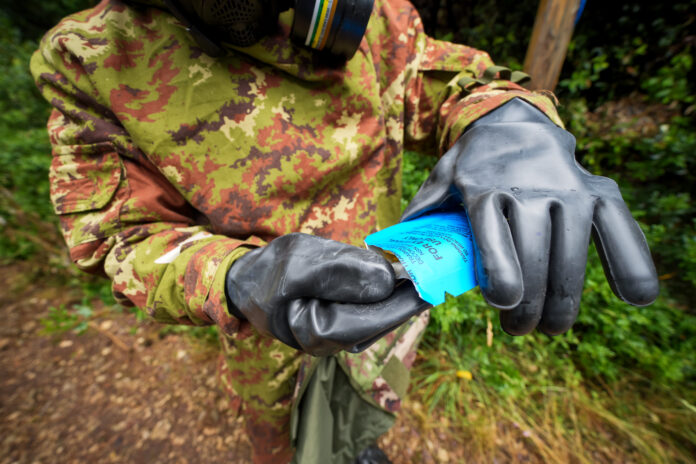
Three confirmed OPCW reports. A battlefield a two-hour flight from Brussels. And most emergency physicians still untrained in CBRN toxidrome recognition.
By: NCT Consultants
Not a hypothetical. A confirmed pattern.
On 18 November 2024, the Organisation for the Prohibition of Chemical Weapons issued its first Technical Assistance Visit report on Ukraine. The conclusion was unambiguous: CS gas — a banned riot control agent under the Chemical Weapons Convention when used in warfare — had been confirmed in samples collected from a trench on the Dnipropetrovsk frontline. [1]
The OPCW published a second report in February 2025, then a third in June 2025, each confirming further use of the same agent in the same region. Three independent laboratory analyses. Three confirmations of the same violation. The use of toxic chemicals as a method of warfare is not an allegation being made by one party — it is now a documented, recurring reality on a European battlefield. [2,3]
This sits within a larger documented pattern. Ukraine’s Ministry of Foreign Affairs reported over 4,600 incidents involving chemical munitions — CS, chloroacetophenone, chloropicrin — between February 2023 and October 2024 alone. The US State Department named chloropicrin specifically in May 2024, noting its use was ‘not an isolated incident.’ The UK sanctioned Russian military units for chemical weapons deployment. Lieutenant-General Igor Kirillov, head of the Russian unit identified as responsible, was killed by a bomb in Moscow in December 2024. [4,5,6,7]
Three OPCW-confirmed reports in eight months. The Chemical Weapons Convention has not collapsed — but it is being tested, systematically, on active European soil.
Europe is responding — but training is a decade behind the threat.
In March 2025, the European Defence Agency contracted NCT Consultants to conduct its first ever CBRN live agent training for EU member state defence units. Hosted at a specialist facility in Slovakia, the exercise used real chemical warfare agents — including VX and Sarin — for the first time in this format. Eight EU Member States participated. [8]
That this was the EDA’s first-ever such exercise, held in 2025, tells you something. The infrastructure for CBRN defence in Europe is being built now, urgently, in direct response to a threat landscape that has already materialised. The military side is accelerating. The medical side is not keeping pace.
A 2024 systematic review on hospital preparedness for CBRN incidents found persistent, structural gaps across institutions: inadequate equipment, insufficient staff training, and no standardised protocols for managing contaminated patients before decontamination. The review noted that all CBRN casualties exhibiting symptoms should be seen by physicians capable of diagnosing and managing them — a standard that, by the review’s own findings, most hospitals are not currently meeting. [9]
A separate 2025 review on prehospital preparedness reached the same conclusion from a different angle: healthcare personnel, particularly in rural areas, frequently lack CBRN-specific training; prehospital responders often operate without adequate decontamination tools; and emergency plans rarely include detailed CBRN response protocols. The study called for urgent improvements across training, equipment, and interagency coordination. [10]
4,600+ chemical incidents reported Ukraine, Feb 2023–Oct 2024 3 OPCW reports confirming banned agents in Ukraine
The clinical problem: recognition comes before everything.
The core failure mode in a CBRN medical response is not a lack of antidotes or equipment — it is delayed recognition. Nerve agent poisoning can present identically to an opioid overdose, an epileptic seizure, or acute organophosphate exposure from agricultural settings. Choking agent exposure mimics acute pulmonary oedema. Radiological exposure may show no symptoms for hours or days after a potentially lethal dose.
A study published in Prehospital and Disaster Medicine in August 2024 examined CBRNe training across US medical schools and found that, despite legislation following the 2001 anthrax attacks calling for high-priority CBRN education, training remains fragmented and inconsistently delivered. A 2024 military medical curriculum paper published in MedEdPORTAL noted that ‘ensuring proficiency in responding to, evaluating, and treating CBRN casualties is a critical component of medical education’ — and developed a new model curriculum precisely because existing ones were insufficient. [11,12]
The gap is not a minor calibration issue. In an actual chemical incident, the window for effective countermeasure administration — atropine for nerve agents, potassium iodide for radiological exposure, specific antidotes for cyanide — is measured in minutes. A physician who cannot rapidly identify the toxidrome cannot administer the right intervention in time. Recognition is the rate-limiting step, and it is the step most consistently undertaught.
Recognition is the rate-limiting step in CBRN medical response — and it is the step most consistently undertaught.
What good CBRN medical education looks like in 2026.
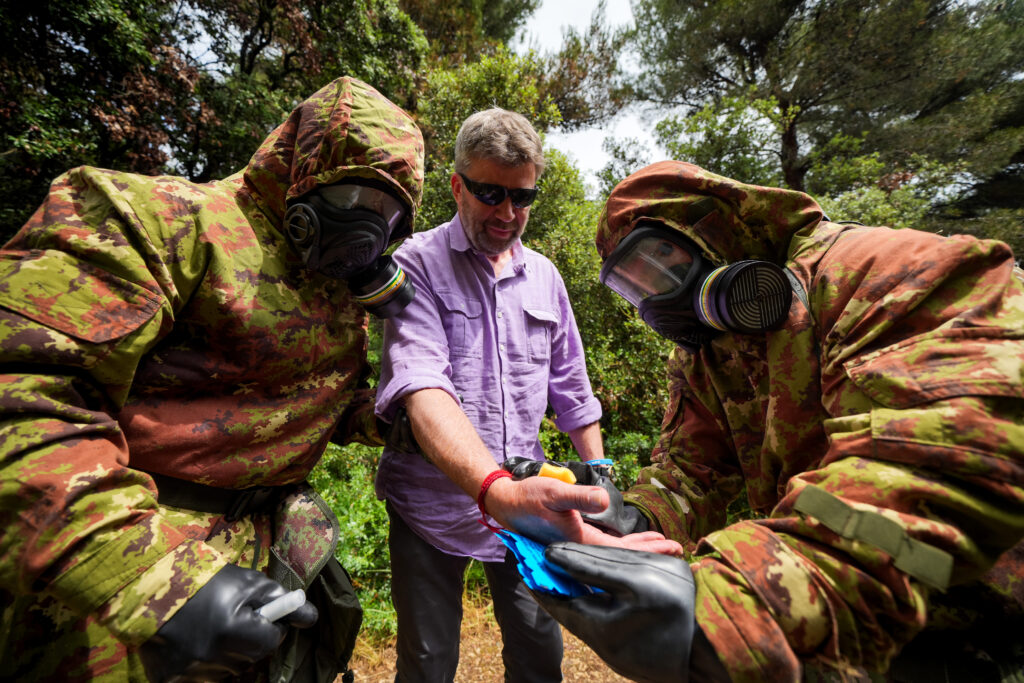
The EDA’s March 2025 training exercise points toward one answer: hands-on, multi-agency, real-agent exposure in controlled settings. That is appropriate for defence specialists. For the broader medical community — the emergency physicians, the first responders, the military medics in non-specialist units, the policy coordinators who must understand what stockpiles can deliver — a different approach is needed.
The elements of effective CBRN medical education at this level are well-established. Toxidrome recognition needs to be taught against real clinical patterns, not theoretical chemical families. Response protocols need to reflect operational realities — what can be done before decontamination, what PPE allows and constrains, when to treat in place versus evacuate. Medical countermeasure training needs to address the practical challenges of administration under uncertainty: incomplete information, time pressure, limited stockpile access.
The European Parliament’s own analysis of EU CBRN preparedness noted that ‘no single entity within the EU has the capacity or competence to manage all aspects of an unfolding CBRN incident’ and that effective response requires a whole-of-government, cross-sectoral approach. Medical preparedness is not a defence problem or a policy problem alone — it sits at the intersection of both, and education needs to reflect that. [14]
Join the conversation.

NCT, in partnership with SERB Pharmaceuticals, is running a three-part webinar series in 2026 addressing exactly these questions — early recognition, immediate medical response, and national preparedness. Chaired by homeland security expert Michael Balboni, with speakers drawn from military medicine, emergency response, and policy. Free to attend. Built for practitioners, not theorists.
Sources & References
[1] OPCW. Technical Assistance Visit to Ukraine — first report confirming CS gas on battlefield. 18 November 2024. https://www.opcw.org/media-centre/news/2024/11/opcw-issues-report-its-technical-assistance-visit-ukraine-following
[2] OPCW. Second TAV report confirming CS in October 2024 Dnipropetrovsk incidents. February 2025. https://www.opcw.org
[3] OPCW. Third TAV report — CS confirmed in further samples. June 2025. https://www.opcw.org/media-centre/news/2025/06/opcw-issues-report-third-technical-assistance-visit-ukraine-following
[4] Chemistry World. ‘OPCW confirms Russia likely used riot control agent CS gas in Ukraine.’ 21 November 2024. https://www.chemistryworld.com/news/opcw-confirms-russia-likely-used-riot-control-agent-cs-gas-in-ukraine/4020569.article
[5] Arms Control Association. ‘OPCW Finds More Chemical Weapons Use in Ukraine.’ April 2025. https://www.armscontrol.org/act/2025-04/news/opcw-finds-more-chemical-weapons-use-ukraine
[6] IISS. ‘Testing the waters: Russia’s use of banned chemicals in Ukraine.’ September 2025. https://www.iiss.org/online-analysis/online-analysis/2025/09/testing-the-waters-russias-use-of-banned-chemicals-in-ukraine/
[7] U.S. Army TRADOC / T2COM. ‘Implications of Russia’s Alleged Use of Chemical Weapons in the Ukraine War.’ February 2026. https://oe.t2com.army.mil/product/implications-of-russias-alleged-use-of-chemical-weapons-in-the-ukraine-war/
[8] European Defence Agency. ‘EDA conducts first CBRN live agent training.’ 13 March 2025. https://eda.europa.eu/news-and-events/news/2025/03/13/eda-conducts-first-cbrn-live-agent-training
[9] Qzih ES, Ahmad MM. ‘Hospital-Based Preparedness Measures for CBRNE Disasters: A Systematic Review.’ SAGE Open Medicine. October 2024. https://journals.sagepub.com/doi/10.1177/11786302241288859
[10] Topcuoglu U, Ersozlu E. ‘Prehospital preparedness of health systems against CBRN threats: A review.’ Turk J Clin Res. 2025;1(1):49–54. Via Global Biodefense, June 2025. https://globalbiodefense.com/2025/06/12/critical-gaps-in-prehospital-readiness-for-cbrn-threats-a-wake-up-call-for-emergency-health-systems/
[11] Sardarian A, Givens M, et al. ‘Introduction to Treating Patients Exposed to CBRN Threats: A Military Medical Case-Based Curriculum.’ MedEdPORTAL. September 2024. https://pmc.ncbi.nlm.nih.gov/articles/PMC11393073/
[12] Prehospital and Disaster Medicine. ‘From Didactics to Disasters: Unveiling CBRNe and Counter-Terrorism Medicine Training in US Medical Schools.’ August 2024. https://www.cambridge.org/core/journals/prehospital-and-disaster-medicine/article/abs/from-didactics-to-disasters-unveiling-cbrne-and-counterterrorism-medicine-training-in-us-medical-schools/DC6F82A6A9E5178BB87D2A5D97A525D1
[13] SIPRI. ‘Reassessing CBRN Threats in a Changing Global Environment.’ Stockholm International Peace Research Institute. https://www.sipri.org/publications/2019/research-reports/reassessing-cbrn-threats-changing-global-environment
[14] European Parliament Research Service. ‘EU preparedness and responses to Chemical, Biological, Radiological and Nuclear threats.’ 2021. https://www.europarl.europa.eu/RegData/etudes/STUD/2021/653645/EXPO_STU(2021)653645_EN.pdf