

by Seán Moorhouse
The war in Ukraine has been raging for 4 long years. It has been the catalyst for a revolution in warfare. A revolution brought about by the use of drones on the battlefield. The introduction of the now ubiquitous drones has had the same effect as the introduction of machine guns in World War 1; it has changed the very nature of warfare.
Had this article been written 4 years ago, the very term ‘drone’ would have implied the Unmanned Combat Aerial Vehicles (UCAVs) that were used with such great success in the unchallenged skies above Afghanistan and Yemen. Indeed, prior to the Russian invasion of Ukraine in 2022, the famous MQ-1 Predator, MQ-9 Reaper and TB2 Bayraktar drones ruled supreme as they overflew insurgent forces and released their precision-guided munitions with great efficiency. These long-endurance, remotely-piloted aircraft are so expensive and use such advanced weaponry that they can only be operated by sovereign states. They still have a role to play in certain contexts but the conversation has moved on and now focuses on the much smaller Unmanned Aerial Vehicles (UAVs) dominating the skies over Russia and Ukraine.
Militaries around the world are scrabbling to catch up with the latest battlefield developments in Ukraine, where the cat and mouse development of drone and counter-drone technology is playing out at lightning speed. When compared to the costs of the legacy UCAVs, the drones used by both sides in Ukraine cost a mere pittance with the majority of the first-person view (FPV) models coming in between $500-$1,000 per unit.
In fact, it is the affordability of these UAVs combined with their availability en masse that is the key to battlefield success. It is the sheer scale of the deployment of drones, especially UAVs, that renders them so effective. This fact is one that Western governments, militaries and defence contractors need to accept. Rather than concentrating on expensive, high-end, bespoke solutions, Western armed forces need a mass of cheap and versatile platforms that they can view as disposable. As Stalin so famously said about the mass of cheap Russian tanks pitted against their well-engineered German opponents, “Quantity has a Quality of its own”.
The relative simplicity of production combined with the low-cost has led to the democratisation of combat drones. Almost anyone can make them and use them, which is having a severe impact on military and security forces worldwide. The use of armed drones has been recorded in countries as diverse as Sudan and Lebanon and their use has spread to criminal gangs. UAVs are no longer restricted to delivering contraband to prisons; they are now delivering explosive devices almost at will. Brazil, Colombia, Haiti Mexico and Panama have all seen criminal gangs use armed drones to attack security forces and rival groups. The genie is now well and truly out of the bottle.
The use of the word ‘drones’ is deliberate. It is an umbrella term that covers Unmanned Ground Vehicles (UGVs), Unmanned Aerial Vehicle (UAVs), Unmanned Surface Vehicles (USVs) and Unmanned Underwater Vehicles (UUVs). UAVs are the weapon systems that garner the most publicity, but all types of drones have been used to deliver explosive ordnance in Ukraine and beyond.
For example, in December 2025, Ukraine used one of its Sub Sea Baby UUVs to badly damage a Russian submarine that was tied up in the Black Sea Fleet base of Novorossiysk. Ukrainian USVs can not only transport UAVs closer to their targets but they can also be fitted with air-to-air missiles to engage aerial targets and have successfully shot down Russian fighter aircraft and helicopters. The older Magura-5 USV used old Russian R-73 missiles (NATO reporting name AA-11 Archer) but the newer Magura-7 uses AIM-9 ‘Sidewinders’. Ukraine’s use of naval drones has been so successful that the country without a real navy has driven the Russian Black Sea Fleet out of the western side of the Black Sea, and its main base in Sevastopol. Its surviving vessels are now forced to hide from Ukrainian USVs and UAVs in a variety of ports in the eastern Black Sea.
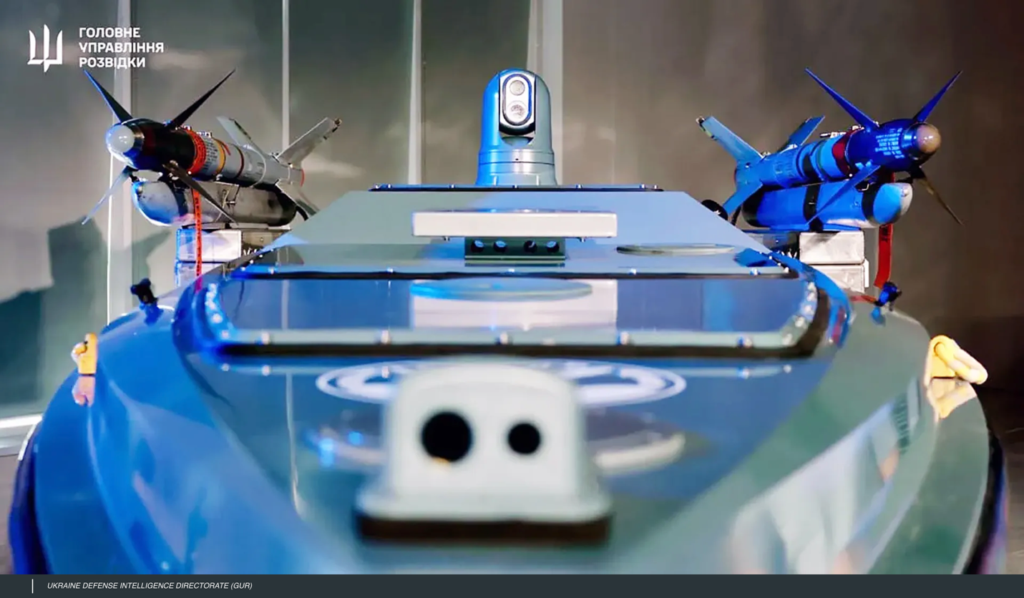
Ukrainian Magura-7 USV fitted with AIM-9 Sidewinder missiles
Both Russia and Ukraine have used ground drones, more properly called Unmanned Ground Vehicles (UGVs), equipped with explosives, in both offensive and defensive roles. Early iterations resembled the old, World-War-2-era, German Goliath vehicles, which were small, tracked vehicles, packed with explosives and steered towards the enemy using a remote controller connected by a long wire. In Ukraine, the Russians started by packing their MT-LB artillery tractors with whatever explosive ordnance came to mind and then steering them remotely towards to Ukrainian lines, with the intention of remotely detonating them when (or ‘if) they reached the target. Ukraine responded by creating much smaller versions loaded with anti-vehicle mines and fitted with thermal sensors. With the aim being to have the devices detonate when they detected the body heat of a Russian soldier, which was significantly warmer than the freezing Ukrainian winter.
Newer iterations of UGVs fulfil a variety of tasks, from casualty evacuation, to logistical resupply, to remote mine laying. Some versions are fitted with machine guns, automatic grenade launchers and/or shoulder-fired rocket launchers from the RPG family.
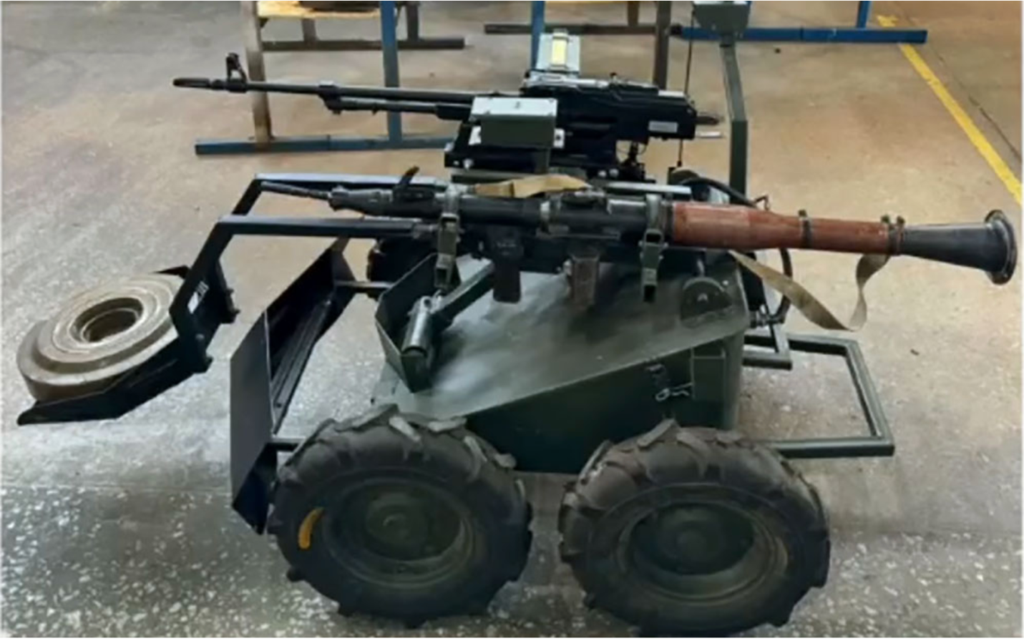
Temerland Gnome UGV. Photo: Temerland
This revolution in drone warfare has left the EOD/IEDD world behind. We lack the terminology to describe what we are seeing. One example of this is the warheads used in one-way attack UAVs, such as the Russian Geran-2, which is locally-produced version of Iran’s Shahed-136. The Geran-2 can be fitted with a range of warheads, from the most common, 50 kg blast and fragmentation version, to a 90 kg blast and fragmentation version and 50 kg thermobaric version. All versions can then be further modified by the addition of an incendiary compound.
What do we call the warheads fitted to one-way-attack drones like the Geran-2? Their role is clear, but there is no existing lexicon that they fit into. There is no lexicon to describe factory-designed and produced one-way-attack UAV warheads. To further confuse the issue, Russia and Ukraine use very similar nomenklatura to describe their drone-delivered munitions. For example Russia’s KOFZBCh is a 90 kg warhead designed to be used on a Geran-2 but Ukraine’s KOFZBCH-3F (note the ‘3F’ added at the end) is designed to be dropped from a bomber drone – the ‘3F’ means that it is in the nominal 3 kg weight class. In English, the Russo-Ukrainian designation ‘KOFZBCh’ can be broken down into ‘shaped-charge, fragmentation, blast, incendiary, combat unit’, so there is a logic to it.
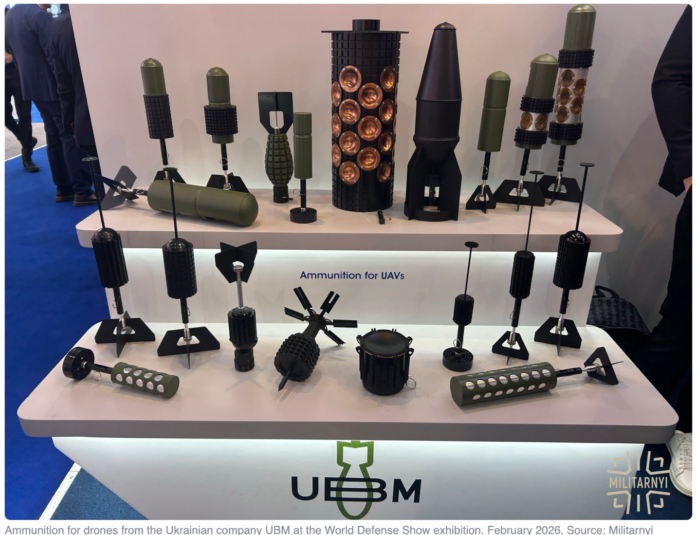
There is a similar gap in our lexicon when it comes to the munitions delivered by bomber drones (UAVs). Bomber drones come in all shapes and sizes and the larger ones can carry impressive payloads (up to 150 kg in some cases). These larger versions, known colloquially in Ukraine as ‘vampires’ or ‘Baba Yagas’ have been seen dropping modified 155 mm high-explosive artillery projectiles and TM-62M anti-vehicle mines. The TM-62M mines are fitted with improvised tail-stabilising units and impact fuzes and are designed to function as bunker buster munitions.
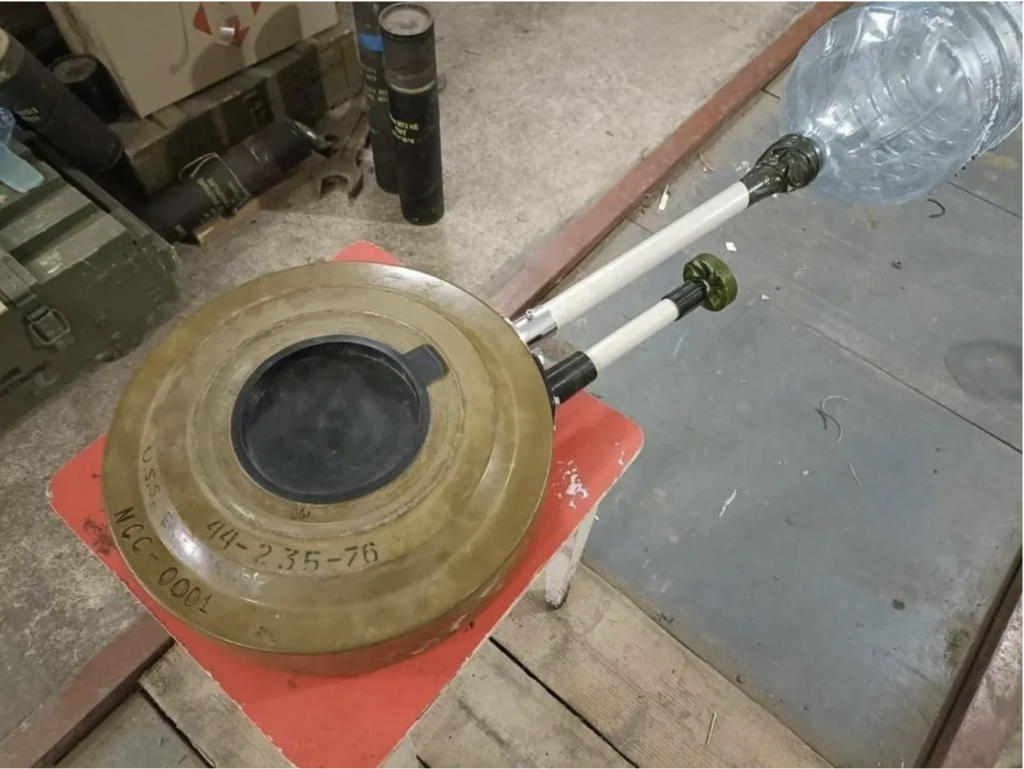
Photograph curtesy of Ukrainian Ministry of Defence
The above photograph shows a TM-62M anti-vehicle mine fitted with an improvised tail-stabilising unit made out of a length of plastic piping and a large water bottle. The improvised impact fuze is contained in the shorter length of piping. M42 submunitions have been used in the role as improvised impact fuzes for these munitions.
Munitions dropped from bomber drones fall into three categories: factory-produced, modified and improvised. Having three categories is controversial, with many in the sector arguing that there are only two: factory-produced and improvised. There is no argument about what constitutes factory-produced but there is an argument about, exactly, ‘modified’ covers that ‘improvised’ does not. When a TM-62 anti-vehicle mine is fitted with a large water bottle to act as a tail stabilising unit and a homemade impact fuze, which is often an M-42 submunition, there is little doubt that this is improvised. However, when a VOG-17 projected grenade has its impact fuze replaced by a 3D-printed impact fuze that is standard across thousands of items, this would constitute a ‘modified munition’ rather than an IED.
That said, there is no place in our existing lexicon to adequately describe a factory-produced munition dropped from a bomber-drone or a munition that has been modified, rather than improvised.
UAVs have also been extensively used to deliver mines, both anti-personnel (AP) and anti-vehicle (AV), into the enemy rear. Many of the AP mines are 3D-printed from widely-available files, which again poses challenges to our existing terminology when trying to describe them, does the EOD world consider 3D-printed mines to be ‘improvised’ or not?
One final challenge presented by drone-delivered EO is the ubiquity of devices fitted with microcontrollers. Microcontrollers are like miniature computers contained within a single microchip. They can be fitted with a range of sensors, such as acoustic, thermal, magnetic light sensitive, etc. Microcontrollers should be giving all EOD operators sleepless nights because their extremely wide usage has reduced the cost down to around $45 each. They are so easy to use yet make very sophisticated devices that pose considerable risk to EOD operators.
In Ukraine, microcontrollers are known as ‘Joniks’, which is a slang term for ‘little soldier’. Joniks are typically fitted with magnetic sensors and have their accelerometers activated, so the mines/devices dropped by UAVs will detonate if any ferric metal disturbs their magnetic field or if moved. They incorporate arming delays and very often self-destruct timers.
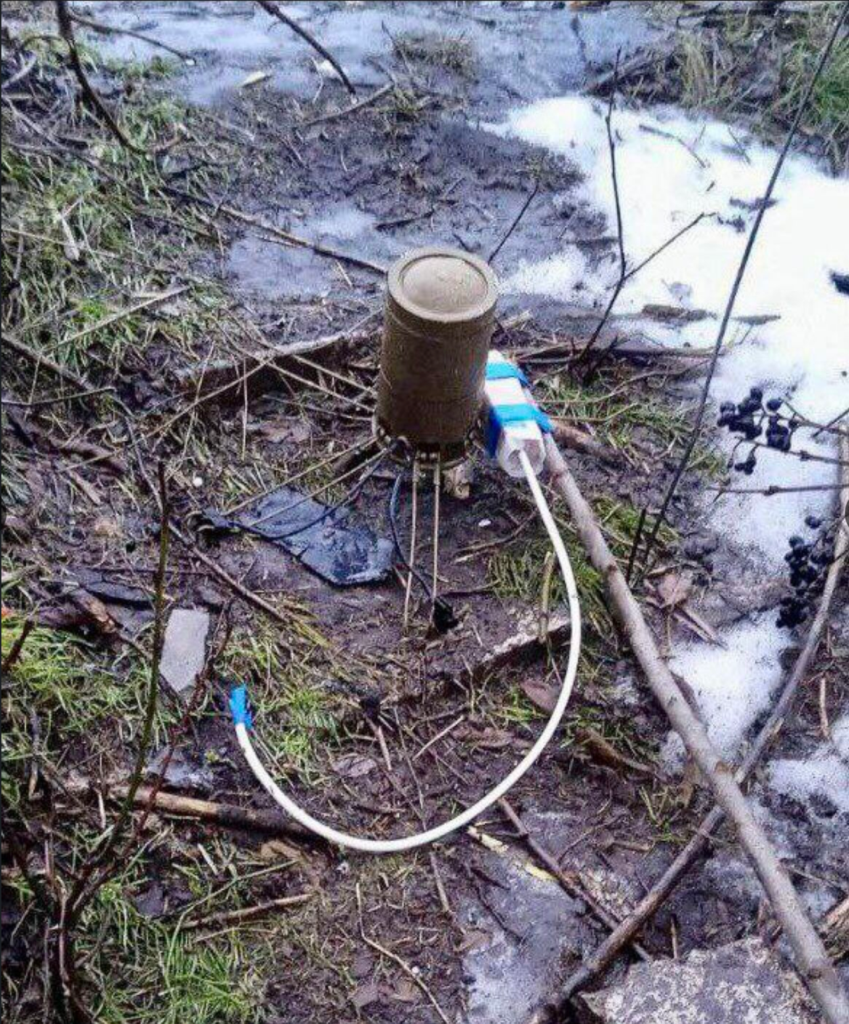
PTM-K2N – dual use – AV-mine and FPV-drone warhead. Incorporates microcontroller with magnetic sensor to initiate EFP warhead at suitable distance from the target. When used as an AV-mine, it also uses an accelerometer, so it will function when moved. Photograph curtesy of the Russian 155th Naval Infantry Brigade
The EOD community is undoubtably behind the curve when it comes to both describing DDEO and addressing many of the challenges it poses. The way ahead is to develop a lexicon of drone-delivered EO, much like the existing EOD lexicon. There also needs to be a discussion about what IMAS EOD level is qualified to deal with what drone-delivered EO. Some items are clearly improvised and require an IEDD qualification but the majority are modified or factory-designed munitions. Owing to the current expansion of DDEO use throughout the world, there is an argument to me made for adding DDEO Disposal to the list of specialities that qualify people as EOD Level 3 Plus operators.