

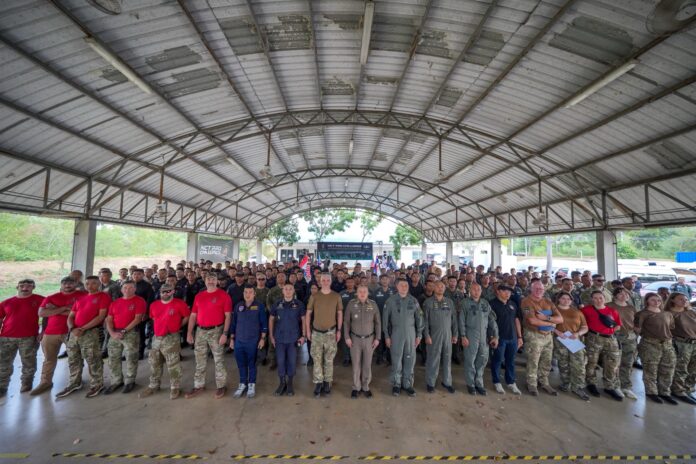
The NCT PRO Challenge Asia 2025 has reached its pivotal midpoint this week, bringing together over 190 specialized operators from 35 elite units across Southeast Asia, East Asia, and the United States for an intensive week-long training initiative focused on countering contemporary EOD, CBRNE, and SOF threats. Hosted across three strategic locations near Hua Hin, Thailand, the exercise represents a landmark convergence of regional and international expertise in addressing the evolving security landscape of Southeast Asia.
From December 14th through 19th, participating teams have been engaged in progressively complex scenario-driven training designed to enhance interoperability, refine tactical capabilities, and integrate cutting-edge technologies into operational frameworks. The exercise is organized in partnership with the Royal Thai Border Patrol Police and supported by 16 leading technology providers.
Strategic Context and Mission Framework
The training architecture centers on a realistic threat scenario reflecting contemporary regional security concerns. Exercise planners developed a narrative involving the fictional Siam Red Liberation Army (SRLA), a sophisticated adversary employing improvised explosive devices and chemical warfare agents. This threat construct mirrors the asymmetric challenges that specialized units increasingly confront in the Indo-Pacific region, where non-state actors leverage accessible technologies to amplify their operational impact.
Structured around a deliberately complex security environment, NCT PRO Challenge Asia 2025 is built on a multinational framework organized into six Joint Sub Task Forces (JSTFs). Each JSTF combines complementary capabilities (EOD, CBRNE, tactical, medical, and forensic) designed to move beyond traditional operational silos and impose a genuinely integrated approach to crisis response. This structure seeks not only operational efficiency, but also the development of shared procedures and trust among civil and military actors from across the Asia-Pacific region.
Training Evolution and Operational Tempo
The exercise officially got underway on Sunday evening at Naresuan Base with an icebreaker that brought together participants, instructors, and technology partners. This initial gathering set the tone for the week ahead, establishing both the operational framework and safety standards. Monday was then dedicated to technology and skills training, during which all JSTFs rotated through industry-led equipment familiarization sessions at the International Law Enforcement Academy (ILEA). Delivered in a hands-on format, this phase allowed teams to build a common technical baseline and become acquainted with the tools that are now being employed in the field.
Since Tuesday, the exercise has entered its fully operational phase. Teams are rotating through scenario-based missions across several training locations in and around Hua Hin, including urban, infrastructure, and tactical environments. These evolving scenarios are designed to mirror contemporary threat profiles and require JSTFs to manage explosive hazards, CBRNE risks, tactical security, and medical response, often under conditions of uncertainty and time pressure.
Activities are coordinated from the Tactical Operations Center at Naresuan Base, which serves as the nerve center of the exercise. From there, instructors and controllers monitor team movements, manage communications, and inject new intelligence to deliberately alter mission parameters. This approach introduces friction and tests the teams’ ability to adapt, reflecting the realities of modern operations.
Training will continue through Thursday, with each JSTF scheduled to complete all operational scenarios by the end of the week. On Friday, the exercise will transition into the culminating PRO Challenge, an intensive evaluation that will test participants’ integration of technical skills, tactical proficiency, and knowledge acquired throughout the week. Regional teams will rotate through seven testing stations at the ILEA and the ranges at Jangyodsuk Tactical Training Base (TTB), assessing capabilities ranging from written examination and X-ray interpretation to radiological detection, chemical identification, tactical combat casualty care, hook-and-line techniques, and live-fire range operations. The day will conclude with an awards ceremony and a commanders’ conference, providing an opportunity to consolidate lessons learned and reinforce the professional networks forged throughout the exercise.
Enduring Impact
NCT PRO Challenge Asia 2025 exemplifies the evolution of security cooperation in the Asia-Pacific region. As threats increasingly transcend national boundaries and exploit technological vulnerabilities, the capacity of specialized units to operate seamlessly across jurisdictional and international lines becomes not merely advantageous but essential. The relationships forged this week in Hua Hin, the technical proficiencies refined through scenario-driven training, and the shared understanding of best practices developed through structured after-action reviews constitute investments in regional security architecture whose dividends will accrue for years to come.
The exercise demonstrates that effective response to contemporary threats demands more than individual national excellence; it requires the patient construction of interoperable capabilities, mutual trust, and shared operational frameworks. As participants continue tomorrow’s final training rotations and prepare for Friday’s culminating challenge, they carry forward not only enhanced technical skills but a deeper appreciation of the collective strength that emerges when elite units commit to learning together.